
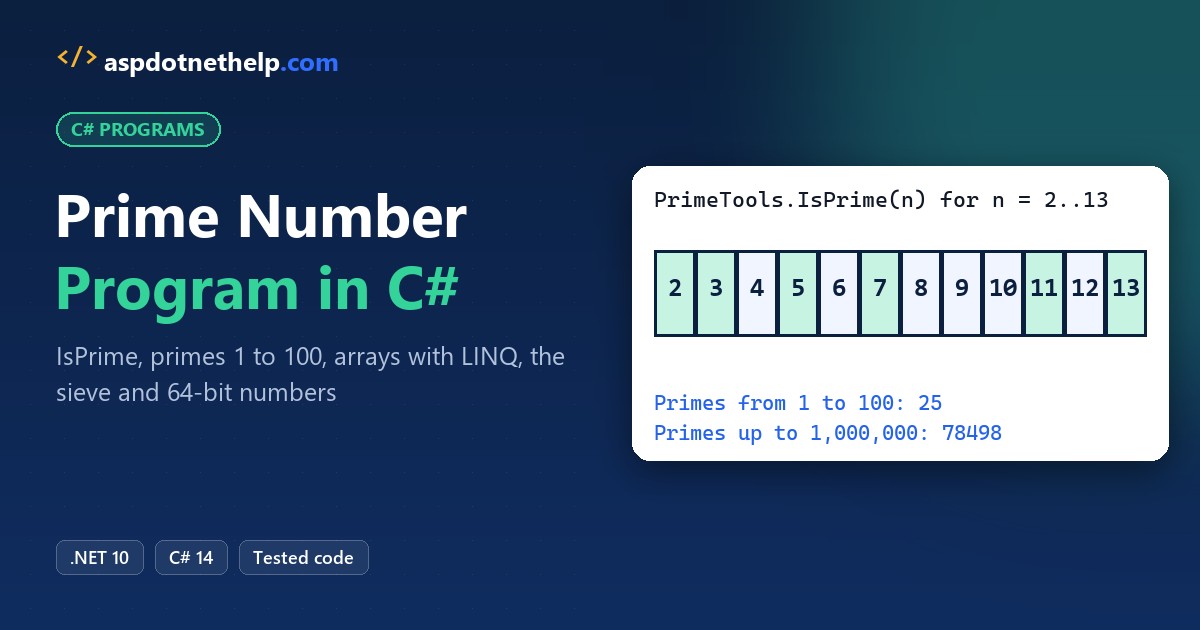
Is 97 prime? A prime number program in C# answers that by trying divisors: return false below 2, return n == 2 for even numbers, then test odd divisors while i <= n / i. If none divides evenly, it’s prime.
In this tutorial, I’ll grow one small PrimeTools class step by step, the way you’d write a prime number program in C#: a basic check, a fast IsPrime, a range, an array, a sieve and 64-bit values.
It’s the version I’d want to see in an interview or a CS course. Each step is a .NET 10 file you can run with dotnet run, with its real output under it.
What Counts as a Prime Number?
A prime is a whole number greater than 1 whose only divisors are 1 and itself. So 1 isn’t prime, 0 and negatives aren’t either, and 2 is the only even prime.
Every method below starts from those rules. Like the Armstrong number program in C#, it’s a small exercise that interviewers use to see how you handle edge cases.
Step 1: Check a Prime Number in C# with a Simple Loop
The first version tries every divisor from 2 to n – 1. I also added the LINQ one-liner you’ll see in older answers, Enumerable.Range(2, n - 2).All(...), so you can compare them:
int[] tests = [1, 2, 9, 17, 25, 29, 97];
foreach (int n in tests)
    Console.WriteLine($"{n,3} -> loop: {PrimeTools.IsPrimeNaive(n),-5}  LINQ: {PrimeTools.IsPrimeLinq(n)}");

static class PrimeTools
{
    // Step 1: try every divisor from 2 to n - 1
    public static bool IsPrimeNaive(int n)
    {
        if (n < 2) return false;          // 0, 1 and negatives aren't prime
        for (int i = 2; i < n; i++)
            if (n % i == 0) return false; // found a divisor
        return true;
    }

    // Same idea as a one-liner
    public static bool IsPrimeLinq(int n) =>
        n > 1 && Enumerable.Range(2, n - 2).All(d => n % d != 0);
}
Output:
  1 -> loop: False  LINQ: False
  2 -> loop: True   LINQ: True
  9 -> loop: False  LINQ: False
 17 -> loop: True   LINQ: True
 25 -> loop: False  LINQ: False
 29 -> loop: True   LINQ: True
 97 -> loop: True   LINQ: True
Both agree, but for a large prime they run almost n times. If the loop syntax is new to you, my guide to the for loop in C# covers it.
Step 2: Faster C# IsPrime Method with the Square Root
Divisors come in pairs. If 7919 had a factor above its square root, it would also have one below it, so you can stop at the square root and skip even numbers after 2. I wrote that loop two ways:
foreach (int n in new[] { 2, 4, 97, 7919, int.MaxValue })
    Console.WriteLine($"{n,10}  i*i: {PrimeTools.IsPrimeSquared(n),-5}  n/i: {PrimeTools.IsPrime(n)}");

static class PrimeTools
{
    public static bool IsPrimeSquared(int n)
    {
        if (n < 2 || n % 2 == 0) return n == 2;
        for (int i = 3; i * i <= n; i += 2)
            if (n % i == 0) return false;
        return true;
    }

    public static bool IsPrime(int n)
    {
        if (n < 2 || n % 2 == 0) return n == 2;
        for (int i = 3; i <= n / i; i += 2)   // can't overflow
            if (n % i == 0) return false;
        return true;
    }
}
Output:
         2  i*i: True   n/i: True
         4  i*i: False  n/i: False
        97  i*i: True   n/i: True
      7919  i*i: True   n/i: True
2147483647  i*i: False  n/i: True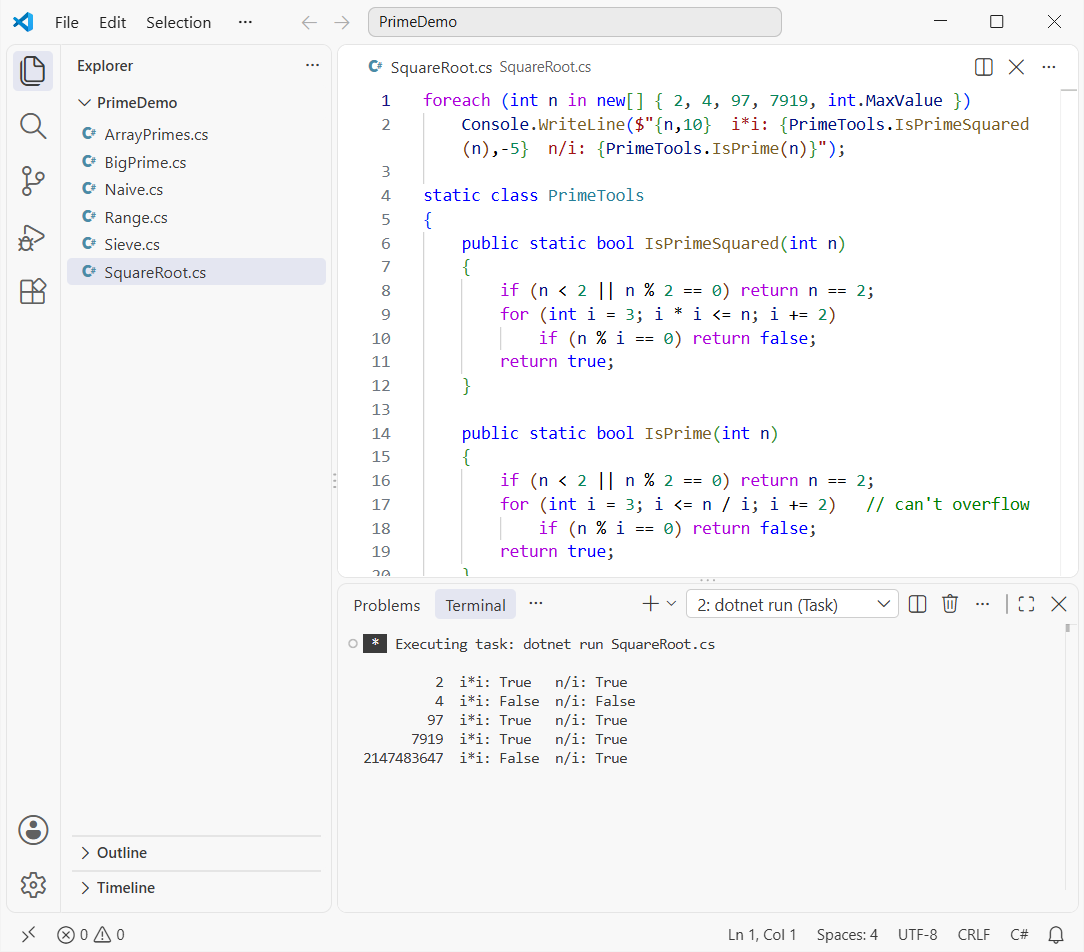
Look at the last row. int.MaxValue is a prime, yet the common i * i <= n loop says false. Once i passes 46,340, i * i overflows, the condition never fails, and the loop eventually tries n itself.
Writing it as i <= n / i tests the same thing without overflow. That’s why it’s the version the rest of this post keeps.
IsPrime is a static method that returns bool, so you can call it anywhere without an object. I explain that pattern in functions in C#.
Step 3: Print All Prime Numbers from 1 to 100 in C#
With IsPrime done, a range is just a loop that keeps the numbers that pass. I also added NthPrime, which counts up until it has seen the nth prime:
List<int> primes = [];
for (int n = 1; n <= 100; n++)
    if (PrimeTools.IsPrime(n)) primes.Add(n);

Console.WriteLine(string.Join(" ", primes));
Console.WriteLine($"Primes from 1 to 100: {primes.Count}");
Console.WriteLine($"10th prime: {PrimeTools.NthPrime(10)}");
Console.WriteLine($"100th prime: {PrimeTools.NthPrime(100)}");

static class PrimeTools
{
    // Step 3: count primes until we reach the nth one
    public static int NthPrime(int nth)
    {
        int count = 0, n = 1;
        while (count < nth)
            if (IsPrime(++n)) count++;
        return n;
    }

    public static bool IsPrime(int n)
    {
        if (n < 2 || n % 2 == 0) return n == 2;
        for (int i = 3; i <= n / i; i += 2)
            if (n % i == 0) return false;
        return true;
    }
}
Output:
2 3 5 7 11 13 17 19 23 29 31 37 41 43 47 53 59 61 67 71 73 79 83 89 97
Primes from 1 to 100: 25
10th prime: 29
100th prime: 541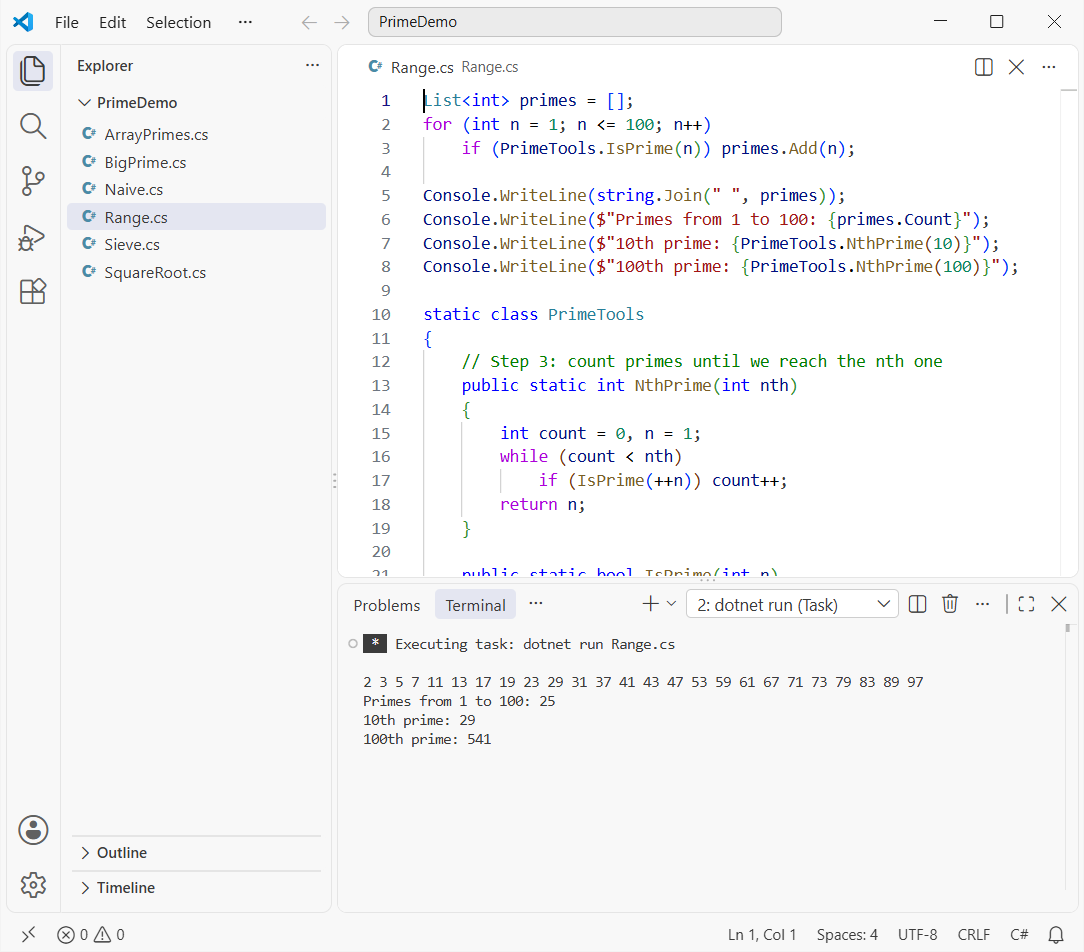
There are 25 primes between 1 and 100, from 2 up to 97, a handy sanity check for any version you write.
NthPrime uses a while loop because you don’t know in advance how far it’ll go. See the while loop in C# if you want the details.
Step 4: Find Prime Numbers in an Array or List with LINQ
Because IsPrime takes an int and returns a bool, you can pass it straight to LINQ as a method group. Here I filter units per order from a Dallas warehouse shift:
// Units per order on one Dallas warehouse shift
int[] units = [12, 17, 23, 30, 31, 45, 53, 64, 89, 91, 97, 1];

int[] primes = units.Where(PrimeTools.IsPrime).ToArray();
Console.WriteLine($"Prime quantities: {string.Join(", ", primes)}");
Console.WriteLine($"How many: {units.Count(PrimeTools.IsPrime)}");
Console.WriteLine($"Largest: {primes.Max()}");

List<int> boxes = [4, 6, 8, 9];
Console.WriteLine($"Any prime in the list? {boxes.Any(PrimeTools.IsPrime)}");

static class PrimeTools
{
    public static bool IsPrime(int n)
    {
        if (n < 2 || n % 2 == 0) return n == 2;
        for (int i = 3; i <= n / i; i += 2)
            if (n % i == 0) return false;
        return true;
    }
}
Output:
Prime quantities: 17, 23, 31, 53, 89, 97
How many: 6
Largest: 97
Any prime in the list? False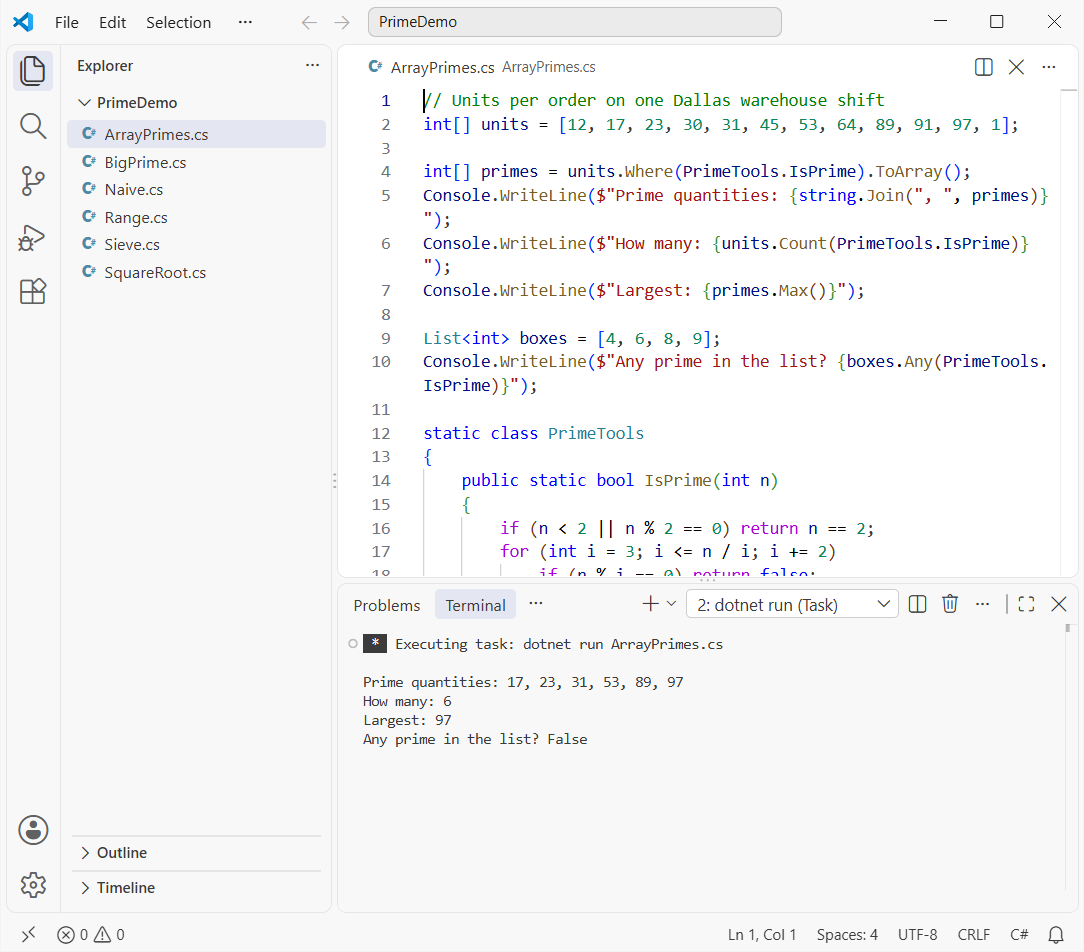
Where(PrimeTools.IsPrime) keeps 17, 23, 31, 53, 89 and 97. It correctly drops 91, which looks prime but is 7 x 13, and 1. The same calls work on a List<int>.
For more on declaring and looping through arrays, read my complete guide to C# arrays.
Step 5: Sieve of Eratosthenes for All Primes up to 1,000,000
Calling IsPrime on every number repeats a lot of work. The sieve crosses out multiples of each prime instead, starting at i * i, and whatever’s left is prime:
bool[] composite = PrimeTools.Sieve(1_000_000);
int count = 0, last = 0;
for (int n = 2; n < composite.Length; n++)
    if (!composite[n]) { count++; last = n; }

Console.WriteLine($"Primes up to 1,000,000: {count}");
Console.WriteLine($"Largest one: {last}");

static class PrimeTools
{
    // Step 5: Sieve of Eratosthenes (true = crossed out)
    public static bool[] Sieve(int limit)
    {
        var composite = new bool[limit + 1];
        for (int i = 2; i <= limit / i; i++)
            if (!composite[i])
                for (int j = i * i; j <= limit; j += i)
                    composite[j] = true;
        return composite;
    }
}
Output:
Primes up to 1,000,000: 78498
Largest one: 999983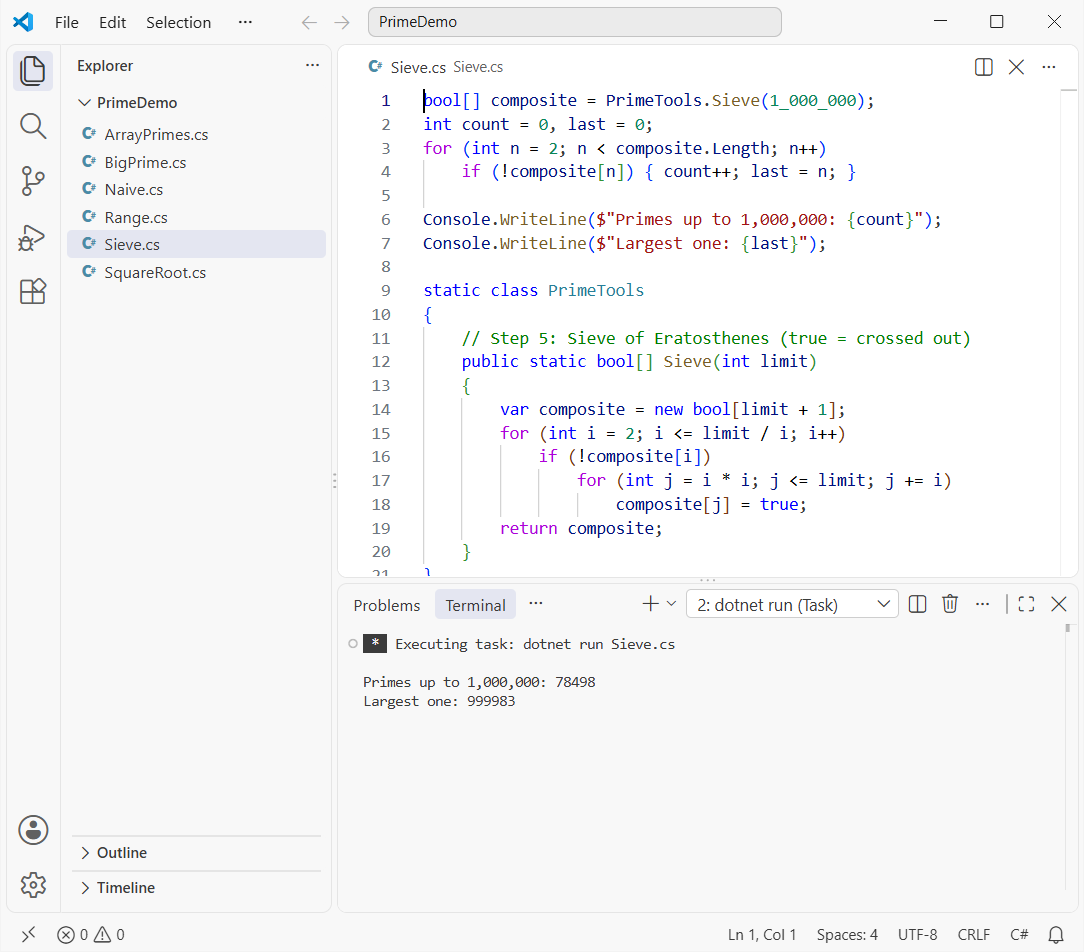
It found 78,498 primes up to one million, the largest being 999,983. I also checked every one of them against IsPrime, and they matched.
On my laptop the sieve finished instantly, while checking a million numbers one by one was noticeably slower. Use it when you need many primes in a range, much like you’d loop once to find the sum of the first n numbers in C#.
Step 6: Check if a long or BigInteger Number Is Prime in C#
For values past int.MaxValue, switch the types to long. I also added the Fermat shortcut from the old version of this post, built on BigInteger.ModPow:
using System.Numerics;

foreach (long n in new long[] { 561, 999999999989, long.MaxValue })
    Console.WriteLine($"{n,19}  Fermat: {PrimeTools.Fermat(n),-5}  IsPrime: {PrimeTools.IsPrime(n)}");

static class PrimeTools
{
    // Step 6: same trial division, now on long
    public static bool IsPrime(long n)
    {
        if (n < 2 || n % 2 == 0) return n == 2;
        for (long i = 3; i <= n / i; i += 2)
            if (n % i == 0) return false;
        return true;
    }

    // Fermat shortcut: fast, but fooled by Carmichael numbers like 561
    public static bool Fermat(long n) => BigInteger.ModPow(2, n - 1, n) == 1;
}
Output:
                561  Fermat: True   IsPrime: False
       999999999989  Fermat: True   IsPrime: True
9223372036854775807  Fermat: False  IsPrime: False
Fermat calls 561 prime, but it’s 3 x 11 x 17, a Carmichael number. Trial division gets all three right, though a 19-digit prime would take billions of divisions.
BigInteger has no built-in primality test in .NET 10, so for huge values you’d implement Miller-Rabin with ModPow. Big values grow fast, as you’ll also see in the factorial program in C#.
Which Prime Number Method in C# Should You Use?
| You need | Use | Result from my runs |
|---|---|---|
| Is one int prime? | IsPrime with i <= n / i | int.MaxValue -> True |
| Primes in a small range | a loop over IsPrime | 25 primes from 1 to 100 |
| Primes in an array or list | Where(PrimeTools.IsPrime) | 17, 23, 31, 53, 89, 97 |
| Every prime up to a limit | Sieve of Eratosthenes | 78,498 up to 1,000,000 |
| A long value | IsPrime(long); Miller-Rabin for huge ones | 561 -> False |
If you’re practicing for interviews, these number programs pair well with this one:
Frequently Asked Questions
How do I check if a number entered by the user is prime in C#?
Read it with Console.ReadLine(), convert it with int.TryParse(input, out int n), and pass n to IsPrime. TryParse returns false instead of throwing when the text isn’t a number.
Is 1 a prime number?
No. A prime needs exactly two divisors, 1 and itself, and 1 has only one. That’s why IsPrime returns false for anything below 2.
Why is 2 the only even prime number?
Every other even number is divisible by 2, so it has a third divisor. IsPrime handles 0, 1 and every even number in one line: if (n < 2 || n % 2 == 0) return n == 2;.
Does .NET have a built-in IsPrime or IsProbablePrime method?
No. BigInteger has no primality method in .NET 10, but it does have BigInteger.ModPow, which is what a Miller-Rabin test needs.
What’s the fastest way to find all prime numbers in a range?
Use the Sieve of Eratosthenes. It crosses out multiples once instead of testing each number, and it found all 78,498 primes up to 1,000,000 in my run.

Bijay Kumar is a renowned software engineer, accomplished author, and distinguished Microsoft Most Valuable Professional (MVP) specializing in SharePoint. With a rich professional background spanning over 15 years, Bijay has established himself as an authority in the field of information technology. He possesses unparalleled expertise in multiple programming languages and technologies such as ASP.NET, ASP.NET MVC, C#.NET, and SharePoint, which has enabled him to develop innovative and cutting-edge solutions for clients across the globe. Read more…